




QC Hosts Important, Inspiring “Violins of Hope” Partnership
By Jonathan Turner
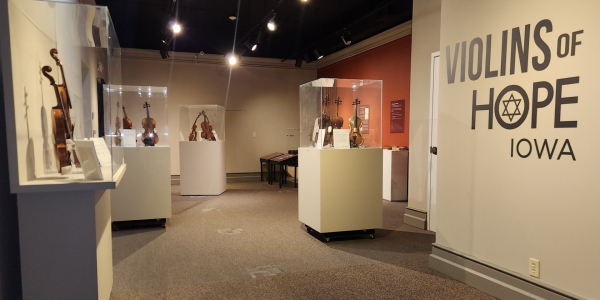
The “Violins of Hope” exhibit is at the first-floor gallery of the German American Heritage Center, 2nd and Gaines streets, Davenport (German American Heritage Center).
The famous author Hans Christian Andersen once said: “Where words fail, music speaks.” And a worldwide traveling exhibit of violins now in the Quad Cities reflects the power of music to heal, inspire and teach.
Violins of Hope Iowa is a powerful and vital international cultural initiative across the state through a unique collaborative residency featuring historic instruments connected to Jewish musicians and the Holocaust. The number of Holocaust survivors dwindles daily (now about 196,000, median age of 87).
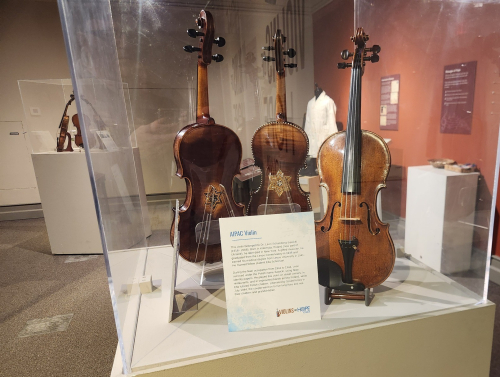
Part of the “Violins of Hope” exhibit at the German American Heritage Center, Davenport (German American Heritage Center).
The Iowa residency this month and through April (which kicked off with a priceless free event Feb. 17 at Davenport’s Putnam Museum and Science Center) includes programming in the QC, Des Moines, Sioux City and Danville, uniting museums, performing arts organizations, schools and community partners in a shared effort to preserve memory, inspire learning and promote hope through music.
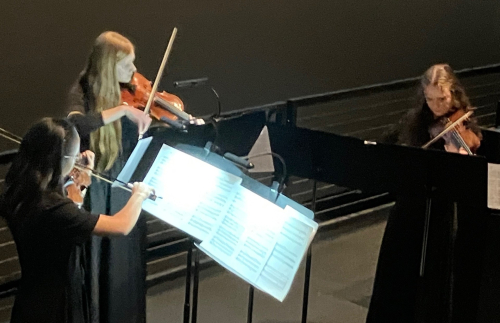
QC students Haven O'Brian, left, Bethany Priaulx and Elise Brock perform on historic violins Feb. 17, 2026 as part of the first “Violins of Hope Iowa” program at the Putnam Giant Screen Theater (photo by Jonathan Turner).
Violins of Hope is a collection of 67 violins, viola and cello that were owned and played by Jewish musicians before and during the Holocaust. Many of the instruments survived ghettos, concentration camps and hiding and now serve as living witnesses to history. Painstakingly restored by master violin makers Amnon and Avshalom Weinstein in Tel Aviv, the instruments are returned to concert stages and educational settings so their stories can continue to be told.
“This is a historic opportunity for Iowa,” said Allan Ross, executive director of the Jewish Federation of the Quad Cities, who helped organize a similar culture-centric collaboration (“Out of Darkness”) in the QC in 2022. “Bringing Violins of Hope to multiple communities across the state allows us to reach diverse audiences and create meaningful connections. This residency is about remembrance, education and hope. It is also about ensuring these stories are shared widely and thoughtfully so their lessons endure.”
Ross first heard about the program in 2019, when it was in Ft. Wayne, Ind., and worked with Violins of Hope leader Avshi Weinstein over the past two and half years to organize an Iowa tour and schedule.
Third-generation Israeli violin maker Avshalom “Avshi” Weinstein was trained by his father, master violin-maker Amnon Weinstein. He began working with his father in their Tel Aviv atelier in 1998 as a maker and restorer of violins, violas and cellos of the highest level.
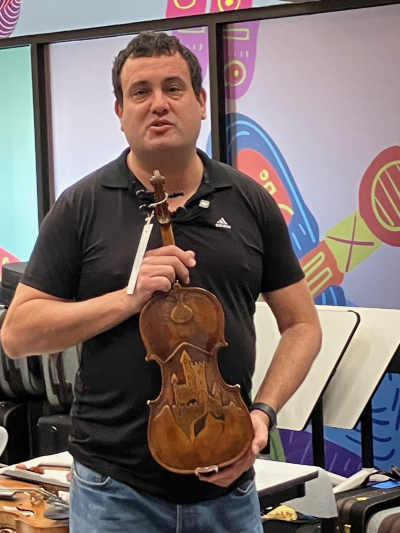
“Violins of Hope” project leader Avshi Weinstein at a media preview for the series at Davenport's Putnam Museum Feb. 16, 2026 (photo by Jonathan Turner).
“The educational aspect is a big deal. First, my father is a Holocaust survivor, so it's very personal to me,” Ross said. “Just looking at some of the studies recently, the lack of knowledge of Holocaust education, especially amongst our young adults, it's shocking what has happened. So it's really important to bring these type of programs where you learn not just the history of what happened, but the lessons learned. That's huge.”
So many students today are bullied and discriminated against, he said, noting prevention and raising awareness are key.
“So bullying, not accepting other people, other ethnic groups, other religions is so hugely important in today's world, especially amongst the students who are going to be our future leaders and young adults,” Ross said. “That's what we're really hoping. This project brings a lot of education.”
Music truly is a universal language that unites all of us, and shows the bonds we share can (and must) be stronger than the differences between us.
Many Quad Cities partners
The QC partners in the project are ATLYS, Ballet Quad Cities, Eastern Iowa Community Colleges, Figge Art Museum, German American Heritage Center, Jewish Federation of the Quad Cities, the Putnam and Quad City Symphony Orchestra.
One of the performers I spoke with recently has close personal and professional connections to the project—soprano Lily Arbisser, a passionate Davenport native who often comes back to perform locally.
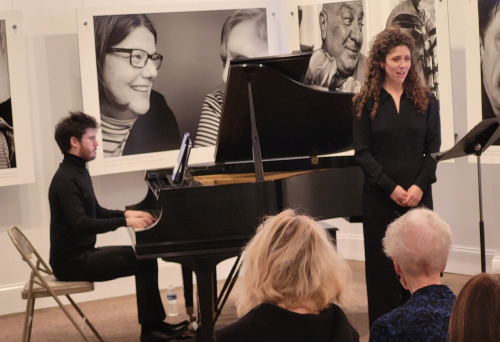
Soprano Lily Arbisser is a 39-year-old Davenport Central alum (Lily Arbisser).
Raised in a Reform Jewish family, Arbisser in 2022 sang the role of Anne Frank in the oratorio “Annelise” with Princeton Pro Musica, and later that year, was in the cast for the Holocaust-themed opera, “Two Remain: Out of Darkness” (2018), performed at Augustana College, Rock Island. Composer Jake Heggie and librettist Gene Scheer’s moving two-act opera – part of the “Out of Darkness” series of events—centers on Holocaust survivors visited by ghosts of their past.
On Thursday, March 26 at 6 p.m., Arbisser will lead a free recital at the Figge – “Remember me, Remember us,” a Missing Voices concert. Missing Voices, founded by French pianist Dimitri Malignan, sheds light on the irreparable loss of Jewish composers during the Holocaust. After a successful concert last year at the German American Heritage Center, he and Lily return for this program in honor of Violins of Hope (whose instruments are being displayed at the Figge, Putnam and GAHC).
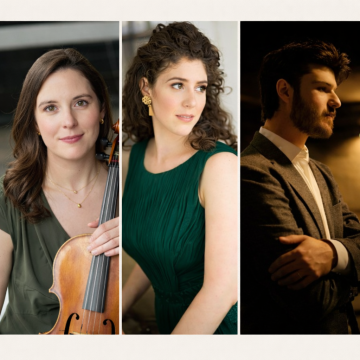
The artists performing a special free concert March 26 at the Figge Art Museum are violist Deanna Petre (left), soprano Lily Arbisser and pianist Dimitri Malignan (Figge Art Museum).
They will be joined by violist Deanna Petre, and the concert will feature music that would have been played in the ghettos and concentration camps—e.g. Mozart, Brahms, Puccini, Schumann—as well as music that was suppressed and music by composers who were persecuted in World War II and the Holocaust. Lily is moved to be part of this invaluable series in the QC.
“Holocaust education is definitely decreasing in frequency, and Holocaust denial is increasing, and anti-Semitism, as we all know, is increasing,” she said. “So we need thoughtful projects like this, and Violins of Hope is a very important message bringer.”
On Saturday, March 28 at 3 p.m., Ballet QC will perform at the Putnam, a program of four ballet pieces that embody the stories, emotion, the history and hope surrounding the Holocaust. With original choreography by Courtney Lyon and Emily Kate Long, the pieces will be accompanied by violinist Emily Nash, associate concertmaster of the Quad City Symphony (they gave a sneak peek of two of them at last month’s Putnam program).
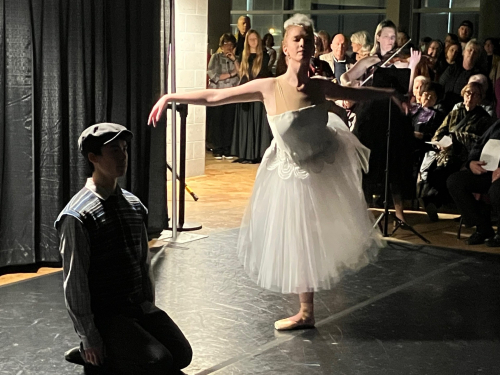
Ballet Quad Cities dancers Marcus Pei and Madeleine Rhode, accompanied by QCSO violinist Emily Nash, at the Putnam balcony, Feb. 17, 2026 (photo by Jonathan Turner).
QCSO musicians visit schools
With the QCSO partnership, thousands of QC students will see some of the instruments up close, with visits from QCSO musicians. At last month’s Putnam event, orchestra executive director Brian Baxter told a story about Alma Rose (1906-1944), the niece of famous composer Gustav Mahler (who died in 1911), who led a women’s orchestra at Auschwitz.
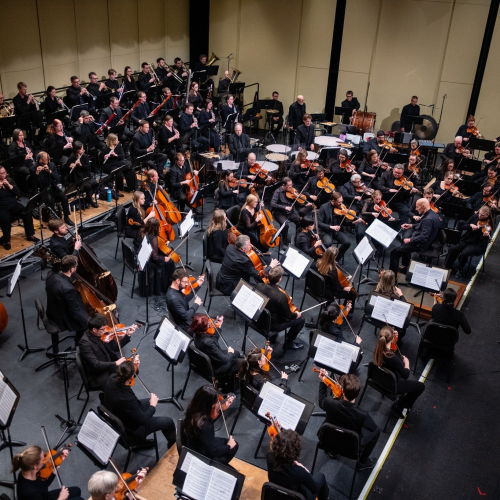
The Quad City Symphony Orchestra is conducted by music director Mark Russell Smith (Quad City Symphony).
“You think about a titan of music like Mahler and his niece ends up in the concentration camp,” Baxter said, noting Mahler was Jewish and converted to Catholicism to save his job. The QCSO Masterworks in April will perform his massive Sixth Symphony.
“It's huge. It's. It's incredible. It'll be overwhelming, but it's just so emotional,” he said. “It's really a triumph over adversity. Mahler was very much all about the entirety of the human experience in his music.”
The April 11-12 concerts also will include J.S. Bach’s Double Violin Concerto, for “Violins of Hope,” and the next weekend (April 18 at the Figge) will be a QCSO Up Close concert at the Figge Art Museum, featuring the appropriately mournful 1936 Adagio from Samuel Barber’s Quartet, and a special string quartet by Steve Reich, “Different Trains” (1988).
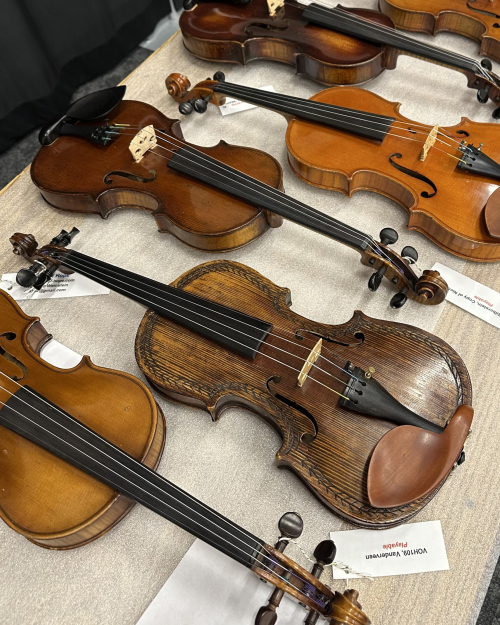
Some of the restored violins that have connections to the Holocaust, at Davenport's Putnam Museum (Putnam Museum).
“It came from his childhood, Steve Reich's childhood,” Baxter said, noting when the composer was one year old, his parents separated – his mother moved to Los Angeles and father stayed in New York City.
“And he traveled back and forth by train very frequently from New York to Los Angeles between 1939 and 1942. And he remembers his trips being sort of romantic and exciting, getting to take the train as a young boy across the country,” he said. “But when he looked back, in hindsight, he imagined, what if I had been in Europe during this period, he was Jewish, and he thought, well, I would be riding much different trains.”
Reich created this piece that reflects the juxtaposition of different trains, in three movements. “So it's going to be a really powerful, moving piece, one of many really exciting events that are going to be happening here,” Baxter said. “Please check out all the events that we're doing. There's so much happening associated with Violins of Hope, and there's so much to learn and so much to share, and I'm just grateful to be a part of it.”
For a full schedule of Violins of Hope events, visit its website HERE.
Jonathan Turner is a veteran journalist and piano player, who has made the QC home since 1995 and loves writing about arts and culture. He is the author of the books “A Brief History of Bucktown: Davenport's Infamous District Transformed,” and “100 Things To Do in the Quad Cities Before You Die”.